
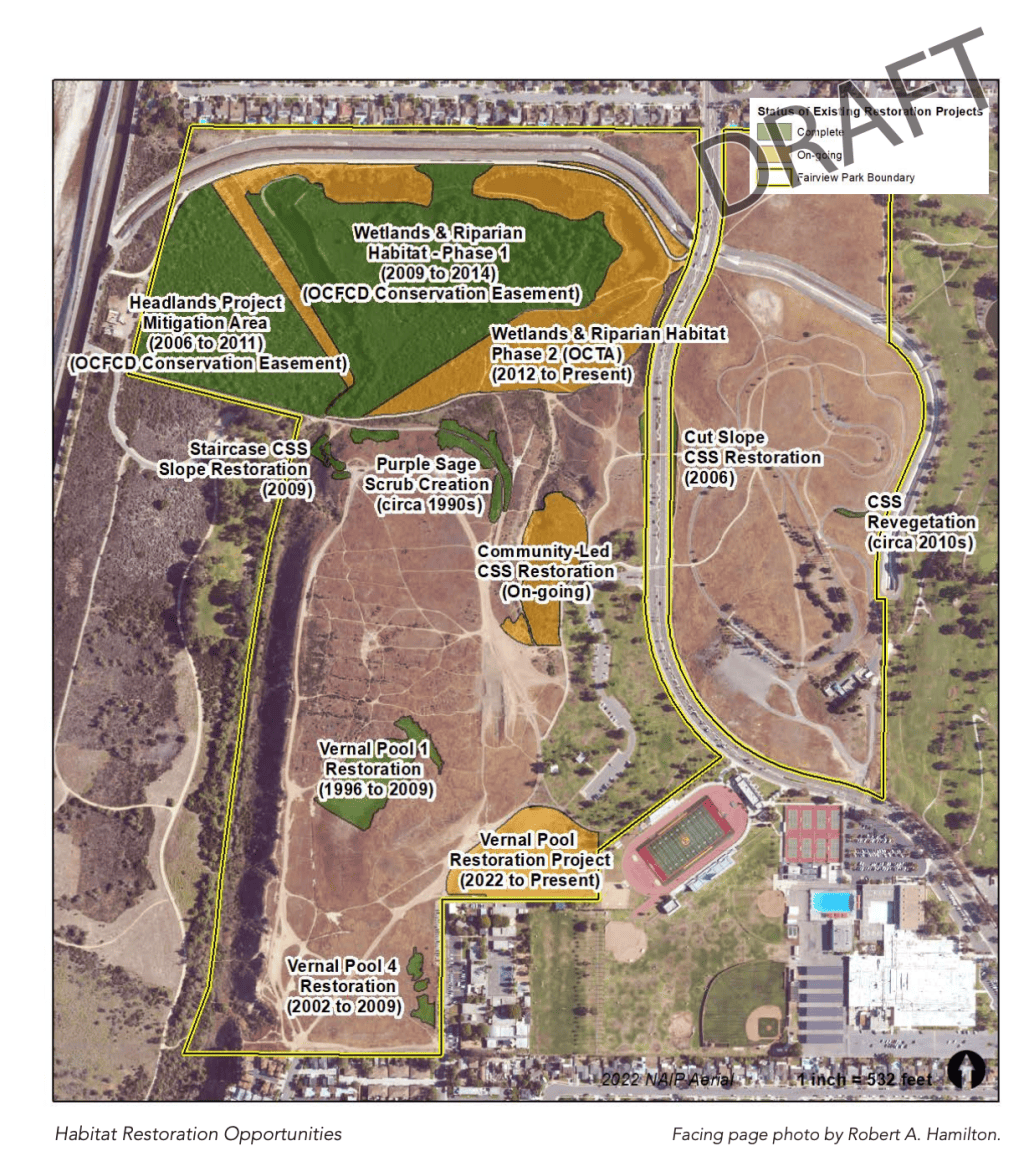
Parks have always been on my mind, even when I’ve been digging into other things. And today, as teased several weeks ago when I was last writing about Fairview Park, I want to share some research I’ve been doing on how we’ve been funding that park for some time.
Buckle up – this might be my longest post evah. So, for the TL;DR set, try this summary first:
- Fund 208, the City’s park development fund, is projected to end this year with a paltry $5,616 available.
- Fund 208’s park fees appear to have paid a ~$340K/year contract to maintain Fairview habitat the City owes to other agencies, mostly closed to the public. This is contrary to Fund 208’s purpose under the Costa Mesa Municipal Code, which is to develop or rehabilitate neighborhood parks.
- Meanwhile, half of our neighborhood parks need repairs, and a $12.95M Westside parkland plan quietly died.
- The new budget commits $1.5M more in park fees (which we may not have) to the Fairview Master Plan Update implementation.
- The contract that I suspect is spending down Fund 208’s park fees expires in January 2027.
- If I’m right, I think the Council should confirm where the money went, possibly repay it back to Fund 208, and wall off future park fees for neighborhood parks and active recreational opportunities.
- If the city wants Fairview Park to go the nature preserve route but can’t afford to maintain it on its own, it should consider making a deal with Orange County to shoulder some of the burden.
With that out of the way: You’ve been warned. What follows is a lot of research, some (hopefully justified) speculation, and some real risk I’m missing some context. But I think it’s important enough to take the shot.
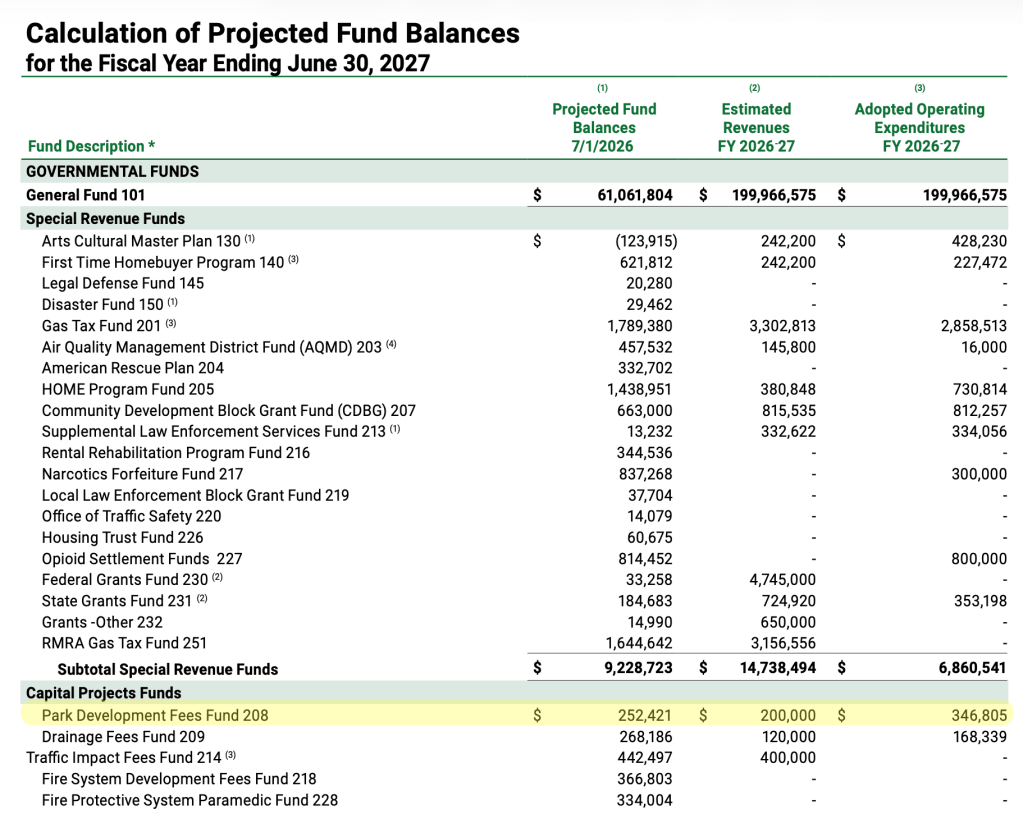
Let’s start at the beginning. I was looking at the budget for this year and I realized something: If I’m reading this right, the fund that is supposed to be paying for the rehabilitation and expansion of our neighborhood parks, the Park Development Fees Fund (Fund 208), is almost completely empty. Take a look at the 2026-2027 Fiscal Year Annual Budget:
Let’s do the math:
Projected Fund 208 balance as of July 1, 2026: $252,421
plus FY 2026-2027 Estimated Revenues in Fund 208: $200,000
less Adopted Operating Expenditures for FY 2026-2027 from Fund 208: $346,805
less the 2026-2027 Adopted Capital Improvement Program expenditure from Fund 208: $100,000 (this line item isn’t included in the table above, but it’s budgeted to the Fairview Park Master Plan Update implementation. More on that in a bit).
That gives me a projected fund balance following this fiscal year of $5,616. That’s the money available after projects the City has already approved. The City’s latest audited financials counted about $2 million in the fund in mid-2025, so I suspect this means most of Fund 208 may already be spoken for. So I believe the uncommitted money is nearly gone.
Here is where I think a good chunk of those Park Development Fees went.
The Park Development Fees Fund: How Developers Pay for their Park Impacts
Every time a developer builds homes in Costa Mesa, it pays fees into a fund for parks (labeled “Fund 208” in the city’s budget books). These fees are generally regulated under the Quimby Act, which specifies that such fees can be collected only for a specific purpose: to acquire, develop, or rehabilitate neighborhood or community park/recreational facilities serving the development. That general idea has been mirrored in the Costa Mesa Municipal Code (CMMC), one section dealing with subdivisions and another with multifamily developments, which together spell out how Fund 208’s monies can be spent: “The [park development fee] […] may be expended [from the park development fee account] only for the purpose of developing new or rehabilitating existing neighborhood or community park or recreation facilities to serve the [subdivision/development] on which the fee is charged.” (emphasis mine).
Distilling the CMMC even further, the City’s own FY 2026-2027 budget book makes Fund 208’s purpose even clearer: Fund 208 was “established to account for the development of new park sites and playground facilities” (emphasis mine).
Yet, despite the fact that Fund 208 is apparently almost out of money, those funds haven’t been used to shower local parks with upgrades. Instead, many of our neighborhood parks are nearly worn out. Recall that the City’s 2025 Park Assessment showed that half of the city’s parks were rated C or D, meaning medium or high priority for repairs.
They weren’t used to get the Westside new parkland, either. In FY 2021-22, the City launched a $12.95 million “Westside Park Development” program, intended to be funded entirely from Fund 208 park fees, for what it called “one of the areas most underserviced for parks.” Then, the next year’s budget set aside nothing for this project. Overall the project only received $250,000, which was never spent. Then the project dropped off the books.
So, if the money isn’t going to neighborhood parks, where did it go?
The Fairview Park “Rehabilitation”
Just looking at the FY 2026/2027 budget, it’s clear that, for the past few years at least, Fund 208 has been paying a recurring operating cost in the Parks department:
| Fiscal year | Park fee revenue | Fund 208 spending on Parks operations |
|---|---|---|
| FY 2023-24 (actual) | $142,598 | $344,382 |
| FY 2024-25 (actual) | $262,786 | $339,410 |
| FY 2025-26 (budget) | $100,000 | $346,805 |
| FY 2026-27 (budget) | $200,000 | $346,805 |
The budget doesn’t spell out which park that operating money serves. However, I have a hunch.
Back in 2022, the City Council approved a “professional biological management and habitat rehabilitation services contract” with Endemic Environmental Services, Inc. In the agenda report for that approval, staff wrote that its funding “is available in the FY 2021-22 Park Development Fees Fund”. That contract’s annual cap, $322,595 (in 2022) to $354,560 (as of January 2026), tracks the Fund 208 line closely.
I sent a written request to the city’s finance department on Thursday, November 12 asking it to confirm that, in line with the 2022 City Council agenda report, Endemic’s fees under this contract have been drawn from Fund 208. The City has responded by saying it needs more time to research the question. Thus, as of this writing, this confirmation is still pending.
So, while we wait: what does the Endemic contract do?
Fund 208 May Be Paying Other Agencies’ Environmental Bills
In 2005, in the City’s own words, Costa Mesa “began efforts to advance the restoration and ecological value of the park by accepting mitigation projects from other entities.”
Mitigation is how agencies and developers make up for environmental damage they cause elsewhere. A freeway widening, a river dredging project or a coastal subdivision destroys habitat. If the builder can’t fully mitigate this damage onsite, it can instead pay to restore habitat at another site and gets credit with regulators.
Fairview Park became one of those sites. Over the following years, the U.S. Army Corps of Engineers (for its Santa Ana River dredging), the Orange County Transportation Authority (for countywide freeway projects) and the developer of the Dana Point Headlands all paid for habitat work at Fairview Park. In this way, Fairview Park became a kind of informal “mitigation bank”: other agencies got the right to restore habitat in Fairview Park, and, in return, those agencies and developers funded the work.
But there’s a catch. The funds for these deals were limited-time payments, but the obligation to maintain the restored habitats is perpetual. Staff explained this in 2022: two “Conservation Mitigation Agreements” with the Army Corps, the Orange County Flood Control District and OCTA “include specific provisions for the City to manage and preserve the habitat areas in perpetuity.” OCTA’s $2 million, for example, was paid out over about a decade and then stopped, with no endowment for upkeep. When the wetlands opened, maintenance was projected at about $40,000 a year. By 2020, the City was spending roughly $350,000 per year.
The staff’s answer to these problems was to hand the management of these ongoing “mitigation” projects to a professional consulting firm: Endemic Environmental.
When Council originally approved the Endemic contract, it approved two years of work at $322,595 a year, plus three one-year extensions with inflation increases. It also delegated authority to the City Manager to sign those extensions without coming back to Council for further authorization.
As of today, all three extensions have been executed:
| Contract Year | Maximum Endemic Fee | Fee Maximum Set by |
|---|---|---|
| Feb. 2022 – Jan. 2023 | $322,595.00 | Original Contract, Feb. 1, 2022 (Council) |
| Feb. 2023 – Jan. 2024 | $322,595.00 | Original Contract, Feb. 1, 2022 (Council) |
| Feb. 2024 – Jan. 2025 | $331,627.66 | Amendments 1 and 2 (staff) |
| Feb. 2025 – Jan. 2026 | $342,239.75 | Amendment 2 (staff) |
| Feb. 2026 – Jan. 2027 | $354,560.38 | Amendment 3 (staff) |
If Endemic has charged the maximum amount of fees every year since 2022, it means the City may end up spending up to $1,673,617 on this contract through January 2027. And that wouldn’t include the contract’s allowed 5% annual contingency. While I can’t confirm at this writing the exact amount Endemic has charged the city every year, I have spot checked the warrants: there are routine checks to Endemic across this period for $10-15,000 every couple of weeks, a spend rate that I estimate should be consistent with billing close to the contract’s cap.
What would park fees get by paying the Endemic contract? Well, it’s not playgrounds. Endemic’s price sheet puts $208,000 of the original $322,595 a year into “Wetland Maintenance”: managing water levels, clearing algae, trimming cattails and keeping access open for mosquito control. Additionally, the 2022 staff report clarified that the core of that site is off limits: “The interior wetland-mitigation landscape is not open to the public“. The City’s request for proposals when it sought Endemic’s services was even blunter: “Managing the Archaeological sites, public use, and manicured park (13 A) are not a part of this bid” (emphasis mine).
In fact, there is some circumstantial evidence that the Staff may have been aware of the poor fit between what was essentially a maintenance contract and the Costa Mesa Municipal Code’s language requiring park development fees to be spent only on “rehabilitating existing neighborhood or community park or recreation facilities”. Take a look at the differences between the language in the Endemic contract and the way city staff described the project in its 2022 staff report:
| Endemic contract (2021–2026) | Staff report to Council (Feb. 1, 2022) |
|---|---|
| “biological, management, and maintenance services” | “biological management and habitat rehabilitation services” |
| “Other park habitat maintenance and management needs” | “Other park habitat restoration and management needs” |
| “Improving vector and maintenance access” | “Improving vector and restoration access” |
| “Continual maintenance of cattail trimming / thinning / mowing” | “Continual cattail trimming / thinning / mowing” |
Additionally, Endemic’s own description of its proposal describes it “management and maintenance“, not “rehabilitation”:
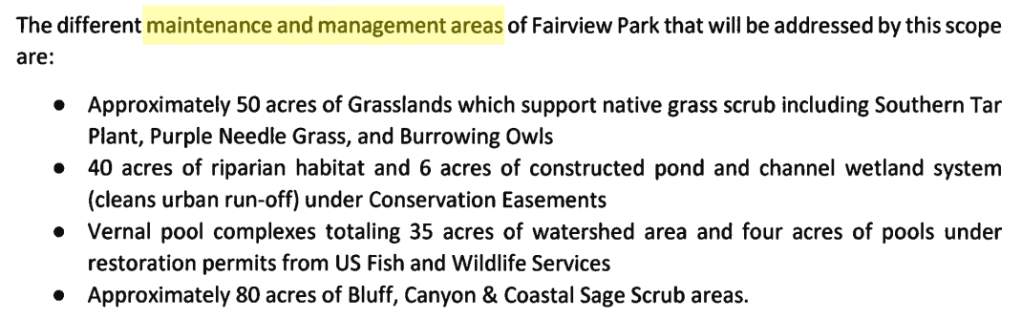
No matter the reason for the wording changes, the result is the same: little of the Endemic contract can fairly be characterized as “developing new or rehabilitating existing neighborhood or community park or recreation facilities.” As the environmental activists interested in Fairview Park have repeatedly and vehemently emphasized, much of the sensitive wildlife habitat subject to the Endemic contract is intended to be protected from public intrusion. That may be a noble goal, but it simply isn’t the same thing as new park space for residents.
The City’s own budget books show Fund 208 paying about $1.76 million in recurring Parks operating costs from FY 2019-20 through FY 2024-25, with another $346,805 budgeted each year since. Pending the City’s confirmation, I think there’s strong evidence that most of it, roughly $1.5 million under the current contract alone, went to Endemic’s recurring maintenance work. If that is the case, then this money wasn’t spent on new parks as the fund intended: it was spent, at least in part, to satisfy the mitigation obligations of third parties, such as OCTA and the Army Corps. Yeesh.
But, as I like to say at these kinds of junctures: don’t worry! It might get worse!
The Future of Fund 208: Even More Fairview Park Spending!
The park development fees in Fund 208 aren’t just paying for Fairview Park’s upkeep. They’re also paying for the effort to update the Fairview Park Master Plan.
The draft Fairview Park Master Plan Update, itself bought with park fees, recommends that “future classification of Fairview Park as an ecological preserve, rather than a community park, should be considered” (draft Master Plan Update, p. 28). It calls for eliminating “incompatible uses of the vernal pool watershed, including maintenance mowing of the fly field” (p. 82). It never mentions park fees.
However, the FY 2026/2027 budget book reveals that the City plans to spend even more park fees to implement the Fairview Park Master Plan update. The new budget creates a “Fairview Park Master Plan Implementation” CIP project, funded entirely from Fund 208:
| FY 26-27 | FY 27-28 | FY 28-29 | FY 29-30 | FY 30-31 | Future | Total |
|---|---|---|---|---|---|---|
| $100,000 | $150,000 | $250,000 | $250,000 | $250,000 | $500,000 | $1,500,000 |
The project exists “to implement Fairview Master Plan elements, and as match for conservation and restoration grants that staff pursue.” Its future maintenance cost is listed as “TBD by FVP Administrator”. While grants sound great (free money! Yay!), there is one problem in this case: grant funding often comes with, you guessed it, long-term, unfunded protection obligations. These projects will add even more acres that need maintenance forever. Under the current arrangement, it’s possible that maintenance will fall back on Fund 208.
Worse, the grants staff would seek would likely have a clear direction. Staff warned in 2023 that continued glider flying risked “jeopardizing future grant funds, for which the park has historically been a strong candidate“. And that is my great fear: that these grant-funded projects, while bringing much-needed financial relief to the city’s depleted coffers, would act as a one-way ratchet. Park fees, which should be used to enhance neighborhood parks and recreation opportunities, would instead be used to match restoration grants. Restoration grants then would add more upkeep costs. Upkeep, in turn, drains the park fund. And each turn takes away a little more of Fairview Park for human use.
In other words, the money in Fund 208, whatever is left of it, wouldn’t be used to increase recreational space. If Fund 208 ends up funding the Fairview Park Master Plan Update implementation, it would be used to decrease it.
Now what?
In the short run, the city should transparently address what is going on with Fund 208, and, if necessary, take corrective action.
With Fund 208 projected to almost bottom out this year, maintaining the status quo is no longer an option. And if my analysis here is correct, or at least directionally correct, the money the city is pouring into Fairview Park is a serious problem. It is eating our park development fund alive and, without a course correction, there is no end in sight.
Therefore, there are a handful of steps I think the city should take immediately:
First, the City should analyze the extent to which Fund 208 has been used to fund Fairview Park’s ongoing maintenance and mitigation obligations. If funds have been spent that way, I sure hope the city attorney will undertake a review to determine if that spending was proper under the Costa Mesa Municipal Code and the Quimby Act.
If there is a problem, there is a simple solution: the city should refund the Fund 208 expenditures out of the general fund, where that spending likely should have landed in the first place. Although that would be a blow to the general fund, Fund 208 could reclaim approximately $1.5 million (plus, arguably, the funds that have been spent on the Fairview Park Master Plan Update, which itself seems like a problematic use of park development funds). Those dollars could then be properly spent on rehabilitating playgrounds, paving pickleball courts, or laying down playing field grass.
Second, the city needs to address the Endemic contract. Endemic’s agreement is set to expire, with no additional extensions available, in January 2027. I would hope that the City Council would instruct the City Manager to agendize, for public review and scrutiny, any proposed renewal of the Endemic relationship. Obviously any future spending along the same lines as the existing Endemic contract should avoid relying on Fund 208.
Third, the city should find a new source of revenue for the Fairview Park Master Plan Update (or shelve the Update altogether). Protecting the environment and rare habitats is a laudable goal. But doing so with money meant to fund active human recreation activities is simply not appropriate.
And fourth, the City Council should reaffirm the Costa Mesa Municipal Code’s vision for Fund 208: it should fund projects that expand resident recreational opportunities, and nothing else. The city is on the cusp of seeing some big projects break ground, such as One Metro West and the Measure K/Housing Element developments. Those will bring in millions in park development fees into Fund 208. So, before that happens, this City Council should be exceedingly clear about what it will allow staff to do with those funds.
In the long run: who should really own and operate Fairview Park?
Yes, that’s a scary question.
Fairview Park costs the City almost $1 million a year in its own budget division alone: $530,346 for staff and $400,805 for maintenance and operations (FY 2026-27 Adopted Budget). That doesn’t count capital projects, grants or the implementation of the Fairview Park Master Plan Update.
If the City ends up taking the position that Fairview Park’s highest, best use is a regional nature preserve, Costa Mesa shouldn’t pay for it alone, and certainly not out of its park development fees fund.
Again and again, Fairview Park’s conservationists and biologists have told us that the park’s value isn’t local. Its vernal pools, bluffs and archaeological sites are described as “regionally significant“. Its mitigation sites earn credit for a countywide freeway program, and for a federal river project impacting multiple cities.
If the resource is valuable to the entire region, the region should share the cost. It is now clear that Costa Mesa cannot afford to fund a nature preserve in perpetuity without impacting other city priorities, such as maintaining its other city parks. Facing that reality means, unfortunately, considering an uncomfortable possibility.
What if the City transferred the habitat-heavy western side of Fairview Park to the County, which already runs Talbert Regional Park next door? Assuming the County would be interested (and it isn’t clear it would be), consider the benefits: the City would rid itself of the burden of the mitigation obligations, some of which were created by county-level agencies. It would shed much of Fairview Park’s operating costs (close to $1 million per year), which include not only the mitigation obligations but also the overhead associated with a full-time, dedicated staff member. And it would stop the drain on city funds that ought to be more equitably distributed across the city’s other parks.
Doing so wouldn’t be easy. The County would have to agree, and be willing to pay. And a transfer would likely need a Measure AA vote. Plus, it’s probably going to be a hard sell to the city’s residents, who love Fairview Park and would likely be suspicious of an OC Parks takeover.
I know it’s not a pleasant thought. But, when looking at what continuing on this path has cost the city, and will continue to cost it in the future, I think all options should be on the table.


Leave a Reply