
This interview with Angely Andrade Vallarta, candidate for Costa Mesa City Council District 4, took place on September 17, 2026. Want to listen to this interview? Check it out on the Goat Hill Rodeo Podcast.
Table of Contents:
*** Begin transcript ***
Introduction
Jenn Tanaka
So today I am talking with Angely Andrade Vallarta. She is running for District 4. So welcome, Angely. So why don’t we just start off with who you are, why you decided to run, and maybe what in your life or your work in the city has led you to this.
Angely Andrade Vallarta
Thank you so much. Thank you so much again for inviting me and being part of this effort to educate our neighbors.
So when it comes to thinking back to when it started for me or what brought me here, it’s really I feel like the-chicken-before-the-egg comparison. I have about 20-plus years in the nonprofit sector, [it] has been my career, my full investment and my career track, starting off in youth education in low-income communities in New York. Then I did some medical graduate education while I was pursuing my master’s degree in Hawaii.
Then I had the biggest job of my life, which was becoming a mother. And that’s when my husband and I realized that we really wanted to settle our roots. And so we would vacation from Hawaii to Orange County. We’re avid water people. So we knew that we wanted to stay close to the shore, [we] had no interest in going back to the East Coast. So we would vacation out here. Sure there was a concert or a museum that was attracting us, but also very intentionally we would road trip from San Diego all the way up to Ventura to really figure out which was going to be our landing spot because, now with the daughter, we really wanted to settle our roots, really build, build our family, provide her with great opportunities for education and opportunities for my career as well.
So we landed in Costa Mesa. [It’s] beach-adjacent, just as quirky and weird as we were. So we figured it was such a great marriage. So once my daughter was born and [she was] okay to fly, we came out here.
And then I had a great opportunity to work with Orange County United Way. I invested eight years at the organization. As you know, they focus on addressing homelessness, financial stability for families, and you know, providing resources to the community. So that experience truly educated me on needs, priorities, issues, challenges countywide and also citywide. The incorporation of [2-1-1 Orange County] has provided very clear data on what each city needs, because they can easily track how many calls each city and constituent is making and be able to understand like – okay, the top calls that [they] receive for Costa Mesa are having challenges to pay rent and needing resources to make ends meet, you know – paying the bills. Those are the top two reasons folks call from Costa Mesa specifically to 211.
So and and during my time there as a new mom, I found myself, I was living [on] Avocado at the time, Avocado Street, and I found myself as a new mom trying to get to a playground, right? You got a little toddler on a stroller. So I’m there, I was like, “oh, perfect. I got a park, kitty-corner to the house, just down the block.” So I’d get my baby on the stroller. But then I faced the terrifying game of “Frogger” that is crossing Wilson Street to get to the playground. So it was really a challenging situation. But once I finally and securely made it, [my] kid is having the time of their life, but because we have a bladder the size of a pea, we found ourselves having to leave the park because there was no bathrooms in Wilson [Park].
Which again, being from the community and understanding, right – I am surrounded by families and children. Why is this not accessible? Why is this not safe for us to just get to the playground?
Then I had the opportunity to meet Council Member [for District 5 Arlis] Reynolds, who was representing me then, and [I] gave her an earful [laughing]. [I gave her] my thoughts as a mom, and the challenges, and what we need. Wilson Street is so fast, it’s not safe to cross. You know, even if I wave down, cars won’t slow down.
So anyways, I got to build a rapport with her and, within a few months or so of connecting with her through various city events, that’s when she invited me to consider to apply [to be] a Parks [and Community Services] Commissioner.
[Photo Credit: Angely Andrade Vallarta for District 4 Campaign]
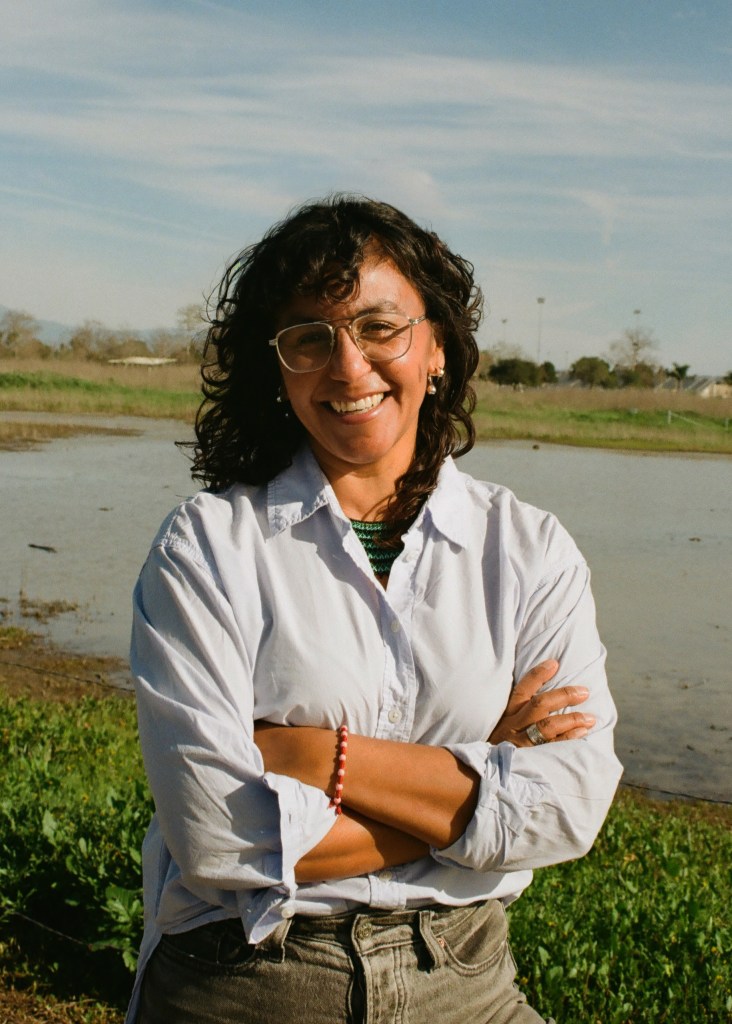
So I jumped in head first and I was very excited to do so because I had all the thoughts, right? Having to get in my car, drive over to the Eastside, right? To give my kid, you know, a different exposure of a different playground, you know, or something that’s more inviting or exciting and that there’s shade where we can comfortably sit while she has a good time. So I found myself doing that trek, visiting Newport Back Bay, to engage with nature and go bird watching and all the things.
So it really exposed me while I was at [the] Parks [Commission] on the inequity of green space that is on the Westside. So I was focused and determined that that’s what I’m going to help prioritize while sitting in [the] Parks [Commission].
[I] quickly understood the lessons and the challenges within that idea or aspiration, right? The lack of accessible land and – prioritization in the budget to actually invest in park development. To explore, to research it, [and to identify:] what are the opportunities? I remember pushing back to city staff like, “why can’t we just – there’s this land over here, we can just turn that into a park?” Well, if we don’t invest for it, the research is never going to be done, [the] data’s not going to be provided, it’s never going to move on. And I just saw that budget line moving year after year in the two years that I was there getting pushed back every year.
Then I’m chasing housing affordability. I now found myself across the street, just across the street on Wilson Street, just a couple of miles down from Avocado [Street] in District 4 now, and meeting [Council Member for District 4] Manuel Chavez now. I got to also build a rapport with him, getting connected, you know, hearing what are his priorities as his new Parks Commissioner now.
So with time, he invited me to then apply for [the] Planning [Commission]. Which again, I worked in the Hawaii State Senate for two years as a Bills analyst. So I was all for it. I was excited to dive in to get a better understanding on what the code is like, land use policies. And again, keeping an eye out for, how can we improve Westside development improvement, especially around green space? I was like, “well, now I’ll be in the place where we get to approve these projects.”
So again, it’s been definitely a huge learning lesson. But I really enjoyed again understanding, getting that dive into approving businesses, developments, and really also leaning into housing development that’s necessary for not just the Westside, but all of our city. So that has been really great in planning.
And so going to your question on what brought me to this decision – it truly was a mixture of things.
As I’m sitting in the dais, whether at [the PACS Commission] at at the time that I was there, and now sitting on [the] Planning [Commission], I mean – just as recent as our last meeting, it was very apparent to me that the perspective at the dais is, you know, maybe it just lacks greater exploration, understanding of the lived experiences of people in my district, of people like me, or even in District 5. So, that lack of understanding or needs or priorities, it’s what drives me to want to run for City Council.
Also, I was very inspired by this wonderful group of women, Las Promotoras de Salud, Orange County, that so many times I would bump into them at City Council [and] just very proudly, very confidently speaking truth to power, providing their comments at City Council meetings [in Spanish]. [It] was really inspiring to me as a Latina woman, right? Because I’m of that generation that was told to assimilate, assimilate as quickly and as fast as you can to be able to succeed in any community, right, here in the States. So I found a huge, a huge inspiration by watching them do that.
And I was like, “if they can do it, they have no shame and very confidently and proudly are who they are.” So they were another really inspirational group that I think brought me there.
And of course, great conversations with folks like [Council Member for District 5] Arlis [Reynolds], [Council Member for District 3] Andrea [Marr], and [Council Member for District 4] Manny [Chavez], to say, “hey, you would be a great candidate, you’re connected with the community and we think that you would be a good fit” [laughing].
Handling street improvements like the W. 19th Street rehabilitation project
Jenn Tanaka
No, no, that’s great. So now we’re going to dive in real quick then with some questions that are specifically about the district you’re seeking to represent on the City Council. So, starting with a really easy one – I’m joking, this is kind of tricky.
You had mentioned your concerns about Wilson Street. I’m going to actually switch to a different street, at least put it in your mind.
Back in 2023, the city completed the West 19th Street rehabilitation project. And this is a pretty significant change to the street. It added protected bicycle lanes, it added a traffic light at Wilson Street, and it reconfigured traffic flow so that the two lanes of 19th Street as you move westbound merge prior to Placentia [Avenue].
These changes caused backlash on social media and in public comment at City Council. That said, last year the Active Transportation Committee reported to the City Council that crashes, particularly crashes involving bicyclists and pedestrians, were down since the rehabilitation project had been completed. So what I wanted to hear from you is, reflecting on the city’s experience here and District 4’s experience here, how would you, in the future, if you had a different project in front of you, navigate the tension between maybe city data and staff concerns about an issue that they see, on the one hand, and how members of the public or particularly vocal members of the public view it, on the other hand?
Angely Andrade Vallarta
Bringing stakeholders that are involved and have that would be directly impacted into any project is absolutely essential. And again, coming from, you know, the nonprofit sector, the route of true service to the community is understanding what does the community need, what does the community want, and what is important to them before any organization, or in this case, the city dictating: this is what you need and this is what you should have and this is how we’re going to address it, right? So I think it’s a combination of stakeholders that need to be at the table.
Yes, data is important because, again – it shows us what are the metrics, what are the the issues in this case, right? Reducing pedestrian mortality. What a wonderful, what a wonderful idea. Yes – I think any resident here in our community wants to feel confident and safe that you know they can let their kids out on a bike and [be] sure and be confident that they’re going to come back in one piece. So yes, data is important to have a clear understanding and see maybe trends, analyses of what’s happening, have expert staff or consultants that get hired to help advise how to address it.
And then of course bringing the community along the conversation. This is what we see [as residents]. This is what [is] being advised. What are [the] gaps? What are opportunities? What are ways that you want to see this resolved? What are other things that maybe, you know, the data doesn’t really show? But again, [does the] lived experience of actually living, commuting, walking in those streets, what’s important to them, bringing it all together, I think for a cohesive, best case scenario to move forward is the most way to…
And also educate the community. Like, “this is what’s happening. This is the best strategies, best practices that have worked effectively.” So it’s also a two-way thing. Again, I think, you know, going back to the example [of W. 19th Street], right? Not living in that very specific intersection or street, maybe, you know, it’s like, [commenters may say], “man, now it’s a little harder to get to Huntington Beach when I want to get there or to, you know, over to Newport.” But let’s have a clear understanding of what’s happening to the people that actually live along those streets, right? So it’s a combination of things. It would also help educate the greater community.
Jenn Tanaka
Do you view it as the role of a City Council person to be the one that brings those stakeholders together or goes into the community and tries to learn who the stakeholders might be? Or is it more – and maybe there’s a third way, so I don’t want to say it’s either way – or is it more that the City Council needs to lead staff to push that process in that direction? Who do you think would take the lead on bringing these stakeholders together?
Angely Andrade Vallarta
Absolutely. I think Council should direct staff. I mean, I’ve seen it effectively done, you know, again, going back to issues around parks. For example, I’ve been following closely the work on the development of Ketchum-Libolt [Park], Shalimar [Park], and they set up wonderful community events, right? Where they get incentivized folks to come by and give their feedback, their insights on what they want to see.
So [I would] continue to have the city continue to pursue that strategy to bring community into the conversation. But I also believe, you know, feedback that I’ve gotten as I’m connecting with neighbors in a deeper way is that: our residents, our neighbors, they want that bridge. They keep telling me like, hey, these [campaign] meet-and-greets are wonderful, but can we please keep doing these even after [the] election? So that to me is actually a great, a really great strategy to: one, educate the residents on, “hey, you know, by the way, this is coming up. What are your thoughts?” Or like, “hey, we’re about to vote on this,” or “hey, we’re thinking about this. What are your thoughts?”
I mean, I constantly hear it in dais [sitting on the Planning Commission, comments] like, “not a lot of people show up to Planning Commission, you know, or [to a] Council meeting,” right? It’s, you know, most of the time, is the usual faces that come through. But this is a way that we break that, I guess, lack of outreach, connection, direct connection to the community. It’s just making it in a more: don’t come to city chambers, but maybe let’s do a meet and greet at the park and just “hey, I’ll be available,” kind of casual conversation, keeping it open so that folks get connected.
So it needs to be a collaborative. City staff, sure, lead it, but also I would love to see, you know, myself. I plan to now – especially hearing from my neighbors that that’s what they want – I plan to come up with ways [to say], “hey, let’s meet at this coffee shop, at this park,” whatever it is, to keep them up to date and hear also what’s important to them, what they’re thinking.
Balancing community needs in large rezoning efforts
Jenn Tanaka
I’m actually going to shift gears a little bit to a planning issue that is front and center, I think, in District 4, certainly will be in the future, which is, you know, Placentia Avenue, a different street, runs down the west side of District 4. And, you know, there, since 2006, development on that street has specifically been controlled, and you probably know this as a Planning Commissioner, the Mesa West Bluffs Urban Plan, which is an urban plan from a while back. And I think that originally had envisioned an area of live work condos, urban lofts, an eclectic mix of industrial and retail businesses.
But 20 years later now, we now have this Neighborhoods Where We All Belong effort, which is a rezoning effort that’s being completed alongside the city’s Housing Element process. And it will significantly alter the Mesa West Plus Urban Plan and add potentially significant more housing to this area. So when you’re shifting from one plan and vision to another, how do you think about balancing the various interests in this area? So you might have housing, but you also have the interests of the existing residents, the existing businesses, commercial vitality. So how do you think about that when you’re thinking about planning issues like that?
Angely Andrade Vallarta
Yeah, I mean I think it teases up back to our previous conversation of bringing stakeholders in. You want to hear, and I do appreciate the work that they’ve done in improving the safety to walk, to bike in that area because that street really carries a lot of, you know, students coming through.
I did hear feedback actually recently visiting with our fire station there in front of Estancia [High School] that, if they if would have adjusted where the bollards are, just a tiny little bit in, it would have been easier to, you know, turn a big old fire truck turning that corner. So that again tells me that, “oh, [the personnel at the fire station] weren’t part of the conversation.” They weren’t asked, like, “hey, by the way, this bike trail is going to be right outside of your station. What are your thoughts?” You know, you want to make sure that they’re part of the conversation.
So I think in the opportunities that are coming along Placentia, I mean I’m supportive of them. One of the ones, for example, that came up recently earlier this year, was a feedback piece on pedestrian safety right on Center Street. That’s been a huge challenge. So many times, I mean, I’m sure you’re a local here too, so you see how many times a car has rammed into that apartment complex right in that corner. So obviously [that] raises concerns again on walkability and safety. So the city exploring having a[n] extended curb and a very fun, you know, just a [colorful] crosswalk, a safe crosswalk for the community there. I think it’s really great.
I travel down Placentia a lot to get to the beach. So I see a lot of folks on the bike path, right? I appreciate that it is protected because it’s still a very speedy thoroughway. The bollards really do provide, you know, as a biker myself, do provide that extra safety. I think [there are] opportunities to continue to collaborate with that industrial space that are, are trying to rejuvenate, right?
I’m sure they are craving some greater urbanization in that area. Because, you know, I’m thinking of that surf company that was right in the corner: it looked great. They had a wonderful community event that I got to go to and I enjoyed, but they couldn’t last. And I get it. There’s not a lot of foot traffic there because again, it’s such a speedy thoroughway, you’re not going to have a lot of folks that are on foot. Like Eller [Bakery] is another great coffee shop that opened up. Wilson Street Coffee is back there as well.
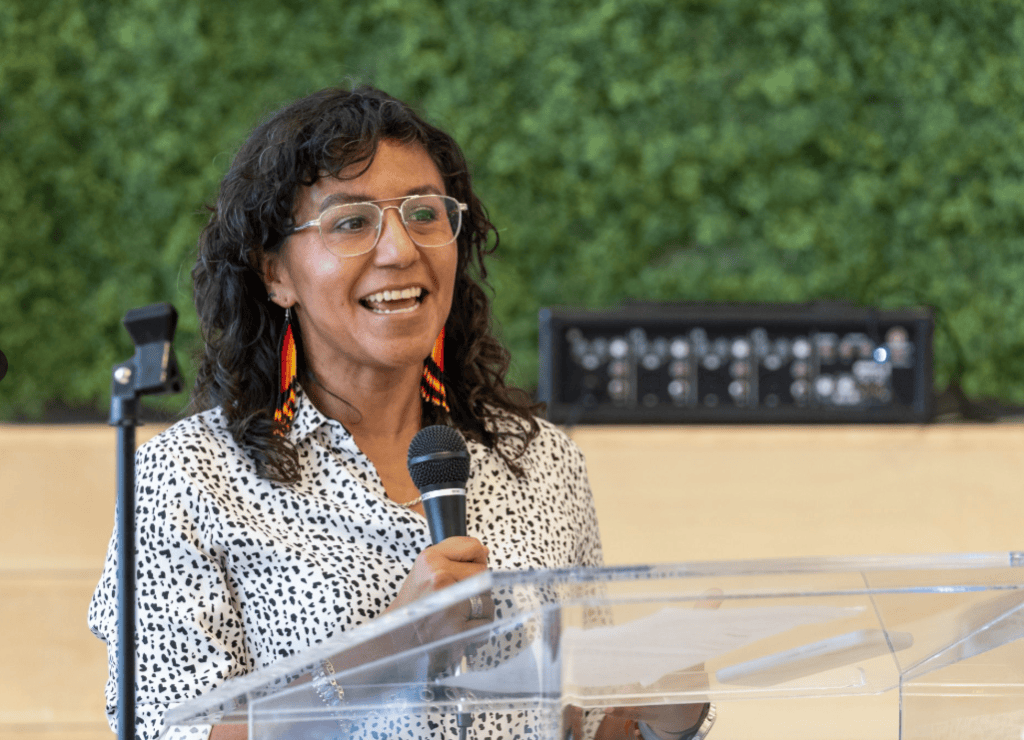
[Photo Credit: Angely Andrade Vallarta for District 4 Campaign]
So I think as long as we maintain an open communication on what’s important, what’s coming, this is what the city is projecting and envisioning – let’s bring you all to the table. Again, having staff to continue to dive into that, they would know best on, like, what are the active businesses that are there.
There’s also a great opportunity to bring more economic development in their area because I do see a lot of, you know, shuttered businesses there. So if, you know, and you mentioned there was a previous plan that covered that area, well, clearly there were some — there’s improvements that could be done to that [planning] project. So the rezoning here hopefully brings some revitalization there and brings some economic development because the previous plan wasn’t effective, for whatever reason, no? So I think it’s a great opportunity to rethink it. Expand on it.
Jenn Tanaka
Then just kind of shifting to a different area, get out of streets and planning – when I was looking at District 4 and coming up with these interview topics, one thing that’s interesting about District 4 is it’s very statistically distinct from other districts of the city. It has, for example, one of the highest concentrations of people who rent their homes. It also has a significant number of people in the city who are multilingual. It reminded me when I was thinking about this, how 2018 was the first election where the city had moved to district based voting from at-large seats. And one of the goals of this move was to ensure that neighborhood level concerns were better represented.
And we’ve touched a little in our conversation already about the difficulty of getting these neighborhood level interests up to the City Council. So, reflecting on the reforms and how’s District 4 has evolved over time, do you think that investment of the city’s time and effort is now more appropriately distributed across the neighborhoods or is there still work to be done?
Angely Andrade Vallarta
100% – I think the districting was essential. I can’t imagine how it could have functioned properly and really truly served the people in District 4 without it being districted. Because again, from my own personal lived experience, right?: If I hadn’t gone to that library event, I would have never met my Council member.
And I’m just that kind of person that wants to be out and about and, you know, expose my kid to all the things that I possibly can because I have a certain level of luxury, right? Sure, I work in a nonprofit, not the most lucrative business, but I have my weekends off, right? But I know that most of my neighbors, most of the working class folk that live in District 4 – and [I] appreciate you sharing those statistics, right, that we’re a predominantly renter district, 79% Latino, right, it’s no news to us. In general, [in] Orange County, 1 out of 3 residents lacked the resources to make basic ends meet. And it doesn’t mean that people are hanging out at home, right? These are families that are working double shifts, late shifts, night shifts, five o’clock in the morning shifts. Like I see my neighbors leaving at six o’clock in the morning. They’re already on the road.
So these are working class folks that don’t have the bandwidth, knowledge, or even where to get started to get engaged with – a planning commission? A parks commission? A city council? [They may be] like, “wait, where is that?” You know, you probably have to double check, right? Like, do they even know where that is? Do they even know? I mean, I’ve as I’ve again engaged with the community, like people don’t even know about [the Costa Mesa] 311 [App].
Our community is also very – maybe, you know, the challenge with the language, English being a second language, – fiddling with 311, that’s not a thing. Like, [it] took me five times to get in and make sure I’m using it properly. So absolutely [the districting had its] benefits. Again, this last Monday meeting, I found myself reminding my fellow commissioners like, “hey, y’all need to walk my neighborhood. Let’s go on a ride along. Come see how we live. Come see some of the quality standards of some of the rental properties that, you know, [are in] communities on Joann Street, where I live, on Center Street, on Shalimar [Street], right? There’s much work to be done in these areas and ensuring that, you know, regardless of your income level. [It] shouldn’t mean that you have a less standard of quality of life in this city.
I am sure that every Costa Mesan deserves to have a voice in what’s happening and how it impacts [them], even if it doesn’t mean that they’re able to go and stand in front of a mic. Because, you know, that is not the easiest thing – to make a public comment.
The way that I’ve seen our community mobilize is when organizations like Bright Youth that are grassroots, you know, Wilson Street Learning Center that is grassroots, Costa Mesa Unidos, that is grassroots, that is bringing them the information [by communicating], “by the way, fellow members, this is what’s happening on the agenda.”
You know, Bright Youth, for example, is a great example where they galvanize that community to come out, and kids to come out and speak, and come out to the speaking sessions to speak about: what do you want in your park? So it’s bringing it to them, making it accessible to them, being multilanguage so that it is accessible.
And at different times. You know, not everybody has the freedom to, you know, come to a commission meeting at 7:00 PM to make a comment or City Council and stay til’ – what was the last meeting?
Jenn Tanaka
12:30 [AM].
Angely Andrade Vallarta
Yeah – to make a comment, right? I mean, I was watching from home myself because Fifth Grade homework is getting hard! So I was watching on Zoom, I commented on Zoom, but I had to, you know, make sure my kid is okay too, right? We all have full, full lives. So absolutely the district thing has [been] positive and there’s more work to do.
It again takes me to why I’m running: I want to be the loud speaker for my community. And so have continuing to have this direct connection with the grassroots organizations that already exist, investing in them in some ways, whatever ways that we can engage. And whether it’s partnerships with the city, that could be also a great place to provide updates and share what’s going on that, again, is going to directly impact [that community].
What would Angely do with $100k for arts in District 4?
Jenn Tanaka
Got it.
You know, I have watched you at the Planning Commission and I have noticed that you’ve made a number of comments championing the arts. And so I wanted to shift to a question about the arts. Let’s pretend that someone hands you $100,000 today to do an art initiative of some kind in District 4. Where does it go and what would it be?
Angely Andrade Adrade
My gosh. My gosh. For the arts. Man, I want to sprinkle it a little bit of everywhere. So one of the key platforms of my campaign is investment in our youth. Again, just based on my work, [and] as a parent, I know – and it’s been proven over and over – because, you know, again, families are busy working double shifts, you know, don’t have the resources to register their kid for “how to play guitar,” “how to learn how to run DJ equipment” or sports, whatever, arts, right? Enrolling your kid in a theater program. Like I mean, you know, I was so fortunate that my daughter receives a scholarship to participate at Arts and Learning Conservatory, because otherwise I wouldn’t be able to afford it. And she loves theater.
So one of the things – okay, I would split up that money.
Jenn Tanaka
And you can have more money if you need.
Angely Andrade Vallarta
So our city has done a great effort in providing, you know, a lot of immersion activity for the community out of the [Recreation] Center. Wonderful.
We need to multiply that as much as possible because capacity is limited. Like even for me, I had to get out of work exactly at 4:45 to be able to pick up my kid, to be able to grab a snag and then bring her right back to gymnastics, change in her leotard to be able to get to the class right at six o’clock. And I was just working by the airport at the time with United Way. So it was a mad race. And again, I had the luxury that I’m off at 5:00, that I could leave 15 minutes early to do so. Not everybody has that capacity when you’re an hourly wage worker, right?
So finding ways to, again, collaborate these grassroots organizations that already – [Save Our Youth, or] SOY is another great example – that are investing in bringing kids after-school enrichment, art exposure, music exposure, classes, you know, career exploration. So really partnering with these organizations to help them reach even more kids is a primary goal of my campaign.
Because we know it’s proven that if you invest in our youth early, find their passion, their likes, the music, the arts, the sports, whatever it is, get them exposed to a career track that they’re personally excited about – so they don’t have a midlife crisis like many, many of us – early, they are less likely to fall prey to nonsense happening on our streets, right? And have a path and excitement about their future.
And arts is a gateway. It is the gateway thing that is going to get kid curious. It did it for me. Dance was the thing that opened my windows to other possibilities. Photography was another thing that really opened my windows to really dive into connection to nature.
And then of course, we’re city of the arts. Let’s lean into that title a little more [laughing]. You know, you’re following the great work that the Arts Commission is doing. But we’re lacking an arts person [on staff at the city], right? I think that the [staff member] that was in charge moved along. So we’ll take some of $100k, pay for a full-time person that actually can move forward the art master plan that the [Arts] Commission worked on.
And spread some color around these walls. I drive along Joanne Street Trail and there’s this big old wall right along the fire station that just gets tagged all the time. I’m like, for all the times that City has had to come in and paint that thing, accumulate all that paint, and with this [hypothetical] grant we just got, [let’s] make it a beautiful, inviting mural where you invite the youth from that same street that are probably the ones that are tagging it, and and beautify that wall.
You know, Eric [Jimenez] from Bright Youth in [the] Shalimar [neighborhood], he’s the one that shared with me that concept. If you’re driving down Placentia, there’s this liquor store and I forget the cross street, but it’s right at the edge of [the] Shalimar [neighborhood]. And I was like, “but why do you want a mural in that weird alley? You don’t really see it when you drive down Placentia [Avenue].” But when I was at a Love Costa Mesa Day [event] and we were planting stuff around there, I went over to see this wall. You gotta walk behind that complex.
And I’m like: “Now, I get it.” Because all the residents that are in this complex, all these complexes are facing that liquor store wall that gets just tagged up like left and right, left and right. I even did a [Costa Mesa] 311 [App] picture thing and, you know, they fixed it, they cleaned it, but a week later it was tagged up again.
But [Mr. Jimenez is] the one that, you know, demonstrated that, you know, in his work that when you invite the youth to participate, engage in it, get hands-on with a beautiful mural on what they want it to be, what’s their passion or whatever, is less likely to be tagged. Right? Because they had a perfect best practice just on the opposing wall. So lots of color, spray lots of beautiful murals along our across our community, invest in art exploration for our youth and find ways to reach them in a more expansive way.
What can the City Council do to improve public trust?
Jenn Tanaka
So now I’m going to shift away from District 4 a little bit. This summer I was reviewing a poll that the University of California at Irvine had put together that looked at how Orange County residents, so not Costa Mesa residents, but Orange County residents all over the county viewed different levels of government. And one question that they asked was specifically how did Orange County residents feel about their trust in local government?
And they said, the responses said, that only 4-in-10 said that they trusted either a little bit or a lot their their local government. So I wanted to see what you thought the city council could do to improve public trust in local government.
Angely Andrade Vallarta
Addressing their needs. What’s important to this community? I’ve seen so many wonderful groups of passionate parents get together and create a work group that is advocating for issues that are important to them. Like thinking of the they had a wonderful name, but the the group of parents that got together for improvements on Brentwood Park. Now, I mean it took years, but that park is amazing.
Jenn Tanaka
The Brentwood Park Alliance.
Angely Andrade Vallarta
There you go. You know, Fairview Park Alliance, right? You know, so many great grassroots organizations [where] our neighbors have gotten together and said, okay, we’re going to band together and really bring forward what’s important to them. Like I know there’s another group that is bubbling up because of this e-bike ban in our school district.
So that demonstrates again that that’s how you build the trust. When people feel heard and their needs addressed, and even just educated – like, okay, sure, everybody wants, you know, every single park improved, you know, but then there are limitations. So it’s a great opportunity to help educate folks: “there’s a timeline, there’s a plan, there’s budget limitations. Let’s think creatively on solutions.”
So again, this is why it’s so important and beneficial to also create corporate partnerships, local partnerships, business, residents, parents, you know, schools together to make decisions, right? Because if you improve quality of life, safety in our streets – I can’t imagine anyone’s going to oppose that, right? Improving access to arts exploration.
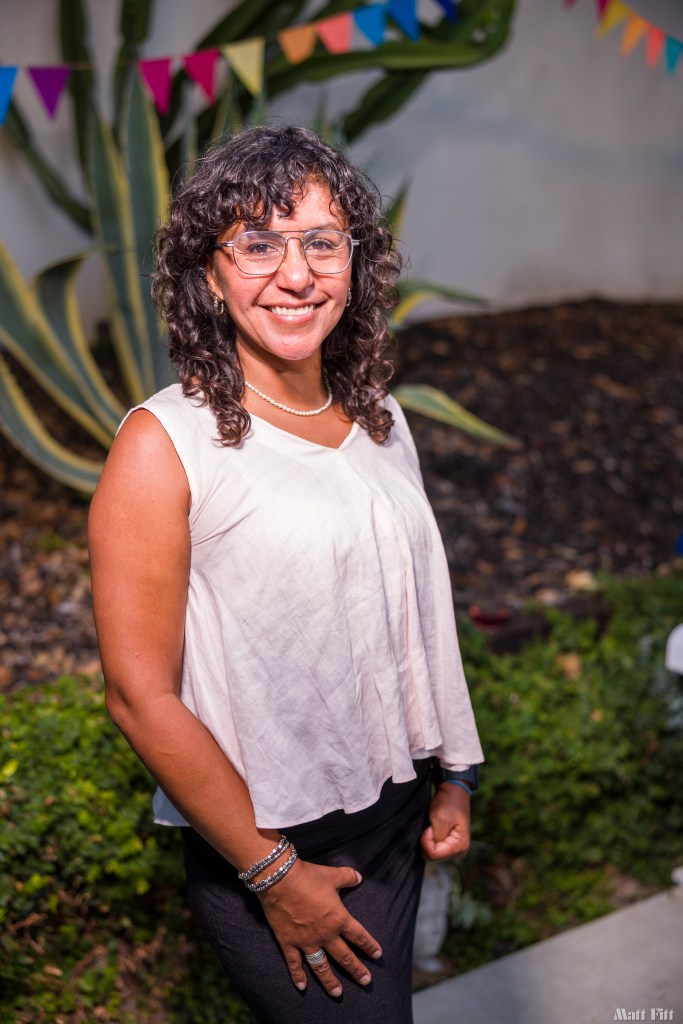
[Photo Credit: Angely Andrade Vallarta for District 4 Campaign]
And so again, I think that the way that you improve it is again listening to the community, educating them – because I understand sometimes issues are complex, so I think that’s about the most effective way, right? And maybe you know, at the local level, it’s much easier to build that trust because, again, we’re addressing basic needs here at the city level. It’s not at the federal level – [that level] gets very politicized [with] Team Blue, Team Red. I mean, none of that really applies here. When it comes to this City Council position, this is not Team Blue, Team Red, this is team Costa Mesa.Because we’re trying to address green spaces, more trees and youth engagement and safety in our streets. Like who can oppose that, right? This is basic everyday issues, quality of life issues that are the same, for no matter whatever team you’re affiliated with.
What is a significant challenge facing the city in the coming years?
Jenn Tanaka
And if you were elected to represent District 4, you would have a four-year term on the City Council. So looking forward into the future, what do you see as a significant challenge for the city as a whole in the next couple years, let’s say?
Angely Andrade Vallarta
Oi. Being attuned to what City Council is looking at now, what we’re looking at now in the Planning Commission. I mean, these are big topics, like you said – the rezoning, we got Fairview Development Center, which are huge projects that are going to define the quality of life for Costa Mesa in like twenty years.
So I find it a very exciting time to really think futuristically and think ahead on: what do I want Costa Mesa to be like? Not for me – but for my daughter, for my daughter’s kids and all her classmates in school and all the wonderful graduates of our local schools?
So I’m really excited for the opportunity to again fold in community input, get that grassroot insight of what people want, what’s important to them so that it is incorporated, right? Getting some perspective also from our youth, because they’re going to inherit – whatever we decide on, whatever we build on, they’re going to inherit. So really building on that, continuing to make the day to day in my four years, the day-to-day in our streets much safer.
I really am excited on expanding, or not expanding, building, establishing our economic development department, right? We often hear in Planning [Commission] – and again, I’m just leaning into that because I hear it so often – leaning into opportunities to grow, to do business development in our city, right? Creating creative ways for startups to actually get started. We have this huge wonderful entrepreneur spirit in our community. Let’s lean into that. That’s what makes Costa Mesa what it is. So I’m really excited to lean into those priorities.
What legacy does Angely want to leave on the City Council?
Jenn Tanaka
What do you want people to say changed because you were representing District 4?
Angely Andrade Vallarta
Yeah. The streets are safer, because that’s what I hear often. No matter what neighborhood I’m in, that has been a common theme. Like you said, building that trust with City Council. People want that connection to leaders, because again, not everybody has the time of day to come out to Council meetings.
And actually something that has been really wonderfully surprising here in my district is improve community policing. I’ve heard over and over that they want police presence. Because right, you know, certain times of day there are negative influence in our streets and building a certain level of just fear. So really that is one of the opportunities that I hope to build upon is relationships with our police department, to really lean into it.
I heard about this wonderful program in the 80s, there was a community policing effort where, like, people knew their local lieutenant and they grew up knowing them and they were around and hang out in the park or connect with neighbors. Because that’s truly what is going to build that level of trust.
Because everybody conflates police, City Council as one big body, right? So really going [to] improve that [community] relationship with our police department and just help them connected to what’s important to them, get to know them on a much more casual level, right? Maybe it’s on foot, maybe it’s on bike, you know, really building those relationships again at the grassroot level to build that trust and also build a sense of safety along our streets. That’s a really great opportunity that I hope to fulfill, should I be elected.
Rapid-fire questions
Jenn Tanaka
So we’re getting too close to the end here. So we just got three rapid-fire questions left. So the first one is, could you name a place for us that in Costa Mesa that brings you peace or happiness?
Angely Andrade Vallarta
Oh my gosh – Fairview Park, Fairview Park, Fairview Park, Fairview Park, Fairview Park. You know, even from when I was living to Avocado, then to Wilson, and now where I’m at on Joann, now I’m even closer to it. So – oh, now that I think about it, it’s progressively brought me closer – but I fell in love with that place the second I moved to Costa Mesa, right? Because I used to go to [the Upper Newport Bay Nature Preserve, or] Back Bay. But then I was like, we have our own Back Bay? What!? So I love it. Fairview Park is the place.
Jenn Tanaka
Awesome. And I was curious if there was a business, but it could also be maybe an institution or tradition that no longer is with us that you really miss. Is there anything that comes to mind?
Angely Andrade Vallarta
Oh my god, you say business – this is honest. I miss EcoNow in the LAB [Anti-Mall]. I don’t know if they’re in the development of it, in the expansion of the LAB. I need them to come back ASAP. It’s a refill store that they have there. Anyways, that was my go to. I spent hours in there exploring all the stuff and getting all my needed supplies. So EcoNow needs to come back in town.
Jenn Tanaka
Awesome. And then the last question is, what’s the best kept secret about Costa Mesa that you’re willing to share?
Angely Andrade Vallarta
Best kept secret. Oh! Well, I don’t know that it’s a best kept secret, but I’m actually kind of leaning into it a little bit more that I wasn’t aware of was – we have, okay, two things that I think of that is like along the way: the Wayfarer. It’s like a really happening music venue. I didn’t realize that. And I guess, you know, a working parent schedule doesn’t really give for a lot of concert going. But that’s been really cool.
And there’s also – I guess is a new best secret secret. There’s a run club that has started here in Costa Mesa. So anybody that’s down to run, there’s this great – again, just a local leader that said, “hey, I want to start a run club. So it’s on Instagram, “Costa Mesa Se Mueve.” Just “Costa Mesa moves”. and yeah, it’s fun. Every Monday, seven o’clock. You know, some I’m in Planning [Commission], so I miss out. But yeah, she does different paths to really explore different areas of the city. That’s been really fun.
Jenn Tanaka
That’s really neat. I hadn’t heard of that group. That’s really cool. Well, Angely, thank you so much.
Angely Andrade Vallarta
Thank you – thank you so much. This was fun.

