

Happy Halloween, everyone! And Happy Election Eve, to those who celebrate.
While we were all out enjoying our soggy (but still fun!) holiday weekend, Some of Costa Mesa city staff were probably absorbing the latest missive the city received from the California Department of Housing and Community Development (HCD).
To catch you up, hopes were high that the city had put the long, municipal nightmare that has been our Housing Element compliance process behind us. We baked our Housing-Element-potato not just once, but arguably thrice: we rezoned all of our Housing Element sites independent of our Measure K sites, then we rezoned them again to comply with the New Commune DTLA v. Redondo Beach case that gutted our mixed-use overlay strategy, and then we finally rezoned the rest of the Measure K sites to implement our Housing Element programs.
And during all of that, staff and City Council also found the time to finalize the Fairview Developmental Center Specific Plan, which was supposed to be the finishing touch that put our Housing Element package over the compliance line.
So, HCD: you wrote us a nice, warm letter to congratulate us on finally achieving Housing Element compliance, right?
For the tl; dr crowd: HCD still isn’t happy, and we’re still out of compliance.
Gosh darn it.
So, what’s HCD’s beef this time?
Problem 1: We forgot (?) to apply Housing Element requirements to FDC
The first set of issues HCD has is that we didn’t include three Housing-Element requirements in the FDC Specific Plan: the “by-right” development status of residential buildings including at least 20% affordable units; the minimum 20 dwelling-units-per-acre for Housing Element sites, and the rule (highlighted by New Commune DTLA) that Housing Element sites must require that a mixed-use development dedicates at least 50% of its total floor area to residential uses/prohibit a Housing Element site from developing 100% of its floor area for non-residential uses.
Don’t worry if those requirements make your eyes cross — I don’t think they’re terribly important in-and-of-themselves (probably?). What is more interesting is that City Hall knew perfectly that well these requirements existed, further more, it and knew exactly how to incorporate them into our zoning code to gain Housing Element compliance. How do I know? Because we already did it when the City put together the zoning code amendments last spring! Check out Ordinance 2026-03, which implemented the rezoning of our Housing Element sites earlier this year:
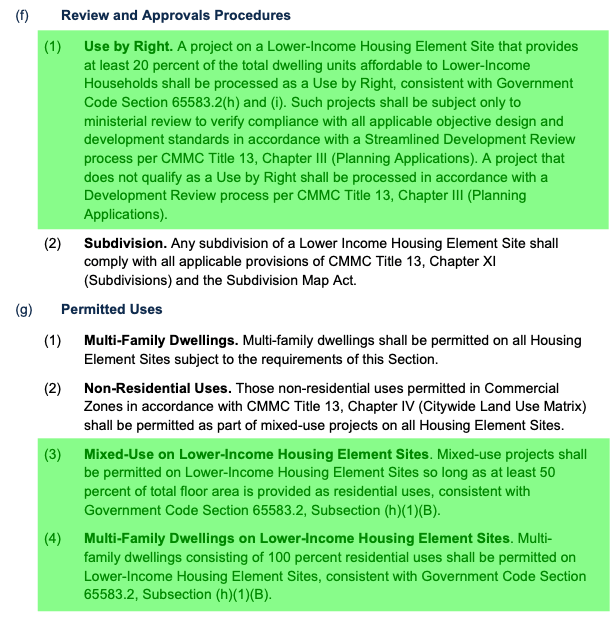
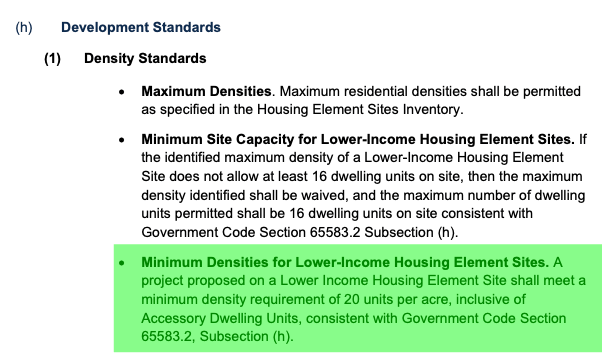
Those highlighted green paragraphs ARE EXACTLY WHAT HCD WANTED IN THE FDC SPECIFIC PLAN. We knew exactly what HCD wanted and we knew precisely the words we needed to get the FDC Plan over the HCD-approval line.
So… what happened?
There is a simple, if unsatisfying possibility. The city used two different consultants for its Housing Element rezonings and its FDC Specific Plan: Dudek for the former, and PlaceWorks for the latter. Is it possible that there was an incomplete hand-off between the Dudek and PlaceWorks teams, such that compliance details that were included in the Housing Element rezonings were overlooked when it came to putting together the FDC Specific Plan? Check out what the Agenda Report from March 2026 said when Dudek was assisting City Staff with the Housing Element rezones:
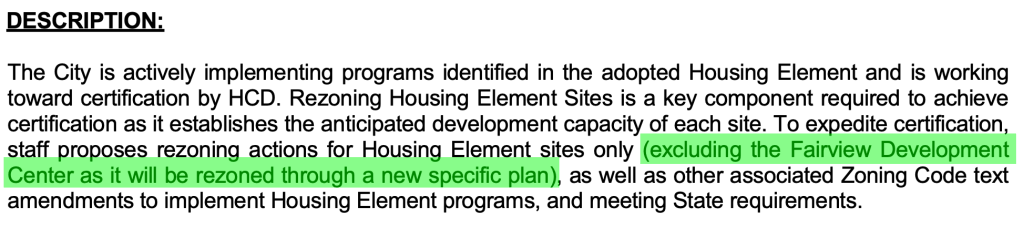
So… the technical details, including the three elements HCD identified in its most recent letter, were *right there* in the non-FDC-Housing-Element rezoning documents. But, despite the Staff anticipating that FDC would need to stand on its own in terms of HCD compliance, it failed to carry over those elements to the FDC Specific Plan.
Now, I’m just speculating this was a mistake. Perhaps these three points are difficult to apply to the specific plan context that covers 80+ acres of land, rather than the individual plots the state regulations seem to anticipate.
But that said, I kinda hope the issues here are due to mere oversights. If they are, they should be easy to fix. If they aren’t…
Don’t worry! There’s more!
Problem 2: Costa Mesa might be done with Ohio House, but Ohio House (and HCD) isn’t done with Costa Mesa
A week and a half ago, 🤖🐐ROBO-Goat helped me out summarizing the settlement agreement the City Council signed off on with the Ohio House, a sober living home that had been the centerpiece of a lawsuit against the city’s sober living home ordinance for many, many years. Innumerable meetings, some wins, some losses, many millions of dollars later, and finally, a definitive settlement with the Ohio House itself, the City’s sober living home ordinance is still on its feet.
But… as part of that settlement, Costa Mesa obligated itself to consult with California Civil Rights Department about its sober living homes: “Respondent City shall, in good faith, participate in discussions about revisions to its zoning code’s definitions and regulations regarding group homes, as well as its reasonable accommodation process, with CRD Legal.”
How, HCD is saying to Costa Mesa that, even if the city resolves the technical issues with the FDC Specific Plan described above, and the city somehow attains the magical status of “compliance” with the Housing Element law, all of that could be undone if HCD ultimately decides that part or all of the city’s sober living ordinance conflicts with State law.
So, it must have been a fun Halloween for the city’s development services department. If you have any left over candy, consider dropping some off in sympathy on Costa Mesa Community Development Director Carrie Tai’s desk. Just when she thinks she’s out, HCD just pulled her right back in.


Leave a Reply